Signature Figures are visual teaching tools developed by the TISA Institute to make key dimensions of professional practice easier to understand, examine, and apply.
Each Figure translates an important aspect of professional practice into a visual structure that supports learning, reflection, and application.
Together, the Figures help make visible some of the processes, influences, and relationships that shape how professionals exercise judgment and act in service to others.
Developing Practice from the Inside Out
The Institute’s educational work recognizes that strengthening professional practice involves more than developing individual skills. It requires attention to how professionals observe, relate to others, reason, govern themselves, pursue excellence, and contribute to the institutions in which they serve.
Across the Institute’s educational architecture, six movements help organize this development:
Observe Clearly · Build Trust · Reason Responsibly · Practice with Self-Governance · Cultivate Excellence · Strengthen Institutions
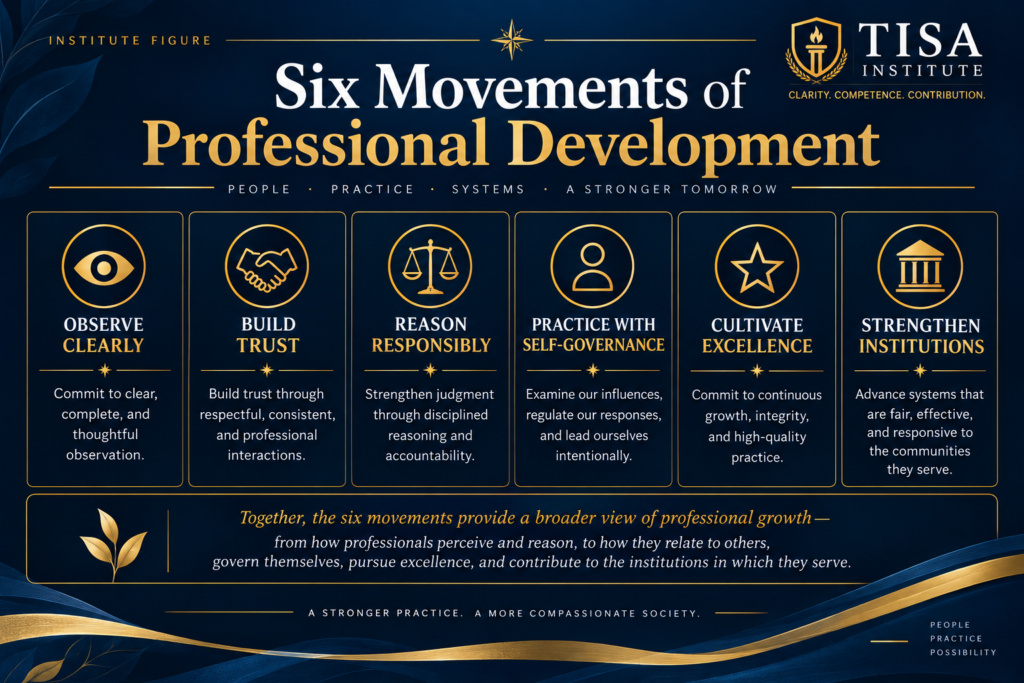
These movements do not replace the Five Professional Actions of the TISA Method. Rather, they provide a broader developmental structure for examining how professional practice can strengthen from individual awareness and judgment to professional relationships, conduct, growth, and institutional influence.
The Trust Pathway
Trust develops through interaction.
In professional relationships, trust is not created simply by intention, expertise, or authority. It develops through the quality of interactions people experience over time. How professionals show up, listen, respond, and follow through can influence whether an interaction contributes to greater confidence and engagement or creates distance and uncertainty.
The Trust Pathway illustrates the professional practices that support the development of trust while recognizing that trust itself cannot be demanded or guaranteed. It must be earned through the quality and consistency of professional interactions.
Be Present · Listen Actively · Respond Respectfully · Act Consistently · Build Trust
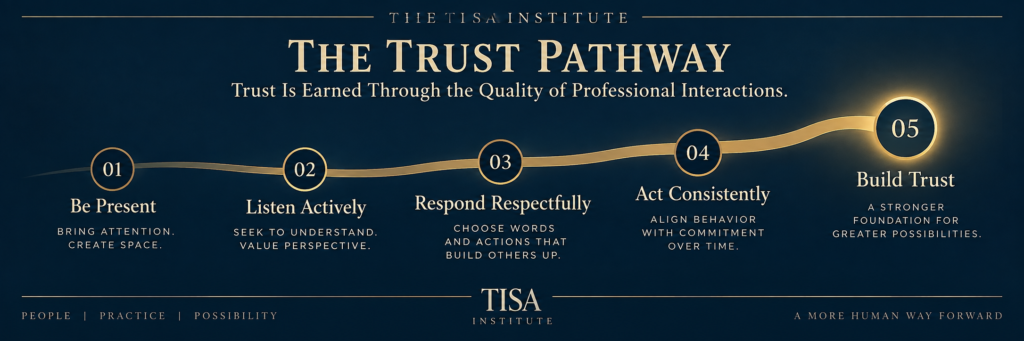
Professionals can create conditions that support trust, but they cannot require trust from another person.
Trust is relational, which means its development is influenced by more than professional intention. A professional may act with care, consistency, competence, and respect while another person remains cautious or unwilling to trust. Prior experiences, trauma history, institutional experiences, power dynamics, cultural differences, and the circumstances surrounding an interaction may all influence how trust develops.
The Trust Pathway therefore places responsibility on what professionals can govern: the quality of their own practice. Being present, listening actively, responding respectfully, and acting consistently can create conditions in which trust may develop, but these practices do not guarantee that it will.
Build Trust represents the cumulative effect of trustworthy professional practice rather than a final task to complete. Trust may strengthen, weaken, require repair, or develop differently across relationships and over time. Professionals remain responsible for continuing to practice in ways worthy of trust even when trust is not immediately given.
In this way, the Trust Pathway does not teach professionals how to make people trust them. It teaches professionals to take responsibility for the quality of the interactions through which trust may be earned.
The Professional Self-Governance Cycle
Professional judgment begins with the professional.
Every professional brings experiences, assumptions, emotions, values, and beliefs into their work. Self-governance does not require professionals to eliminate these influences or pretend they do not exist. It requires awareness of how those influences may shape perception, reasoning, judgment, and action.
The Professional Self-Governance Cycle illustrates an ongoing practice of recognizing internal influences, reflecting on their potential impact, regulating what may interfere with sound professional judgment, remaining open to other possibilities, and choosing how to act ethically.
Recognize · Reflect · Regulate · Remain Open · Act Ethically
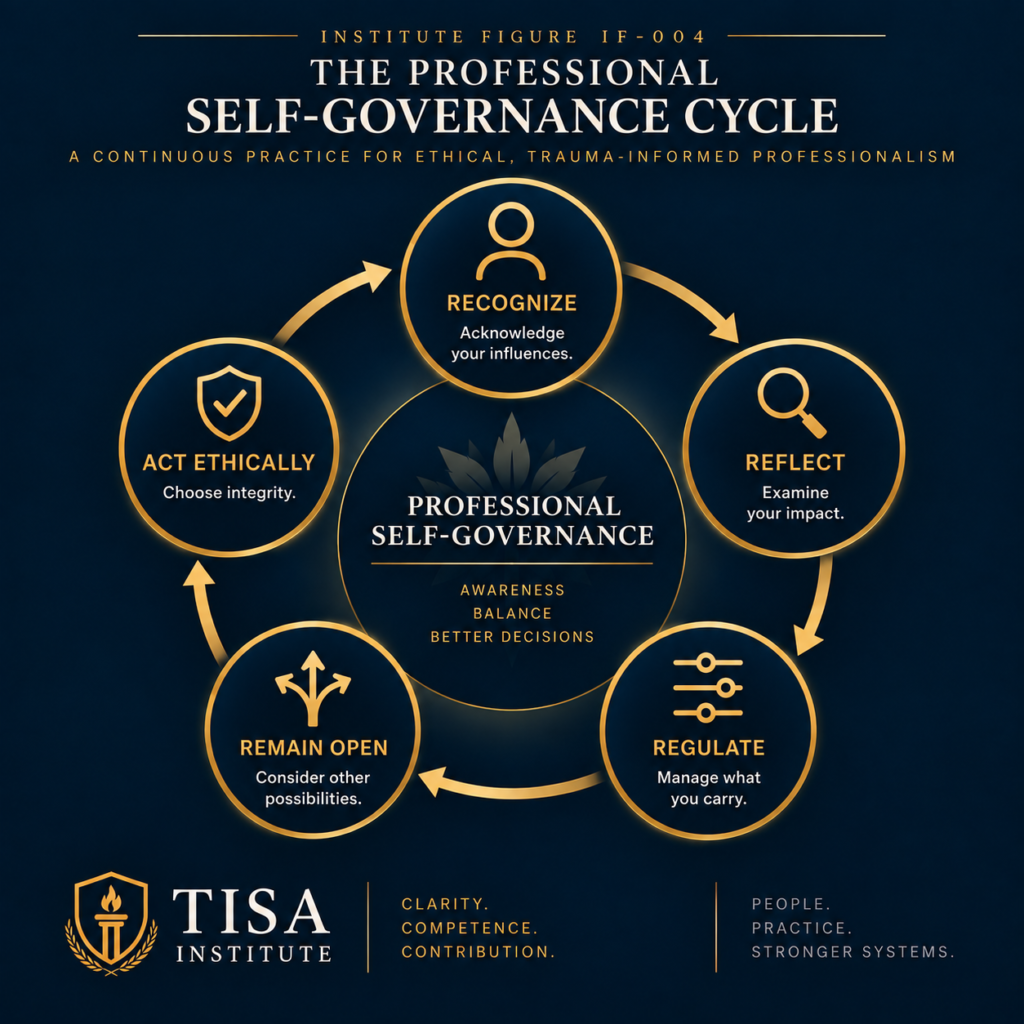
Self-governance is a continuous professional practice.
The Professional Self-Governance Cycle illustrates how professionals can remain accountable for the personal experiences, emotions, values, beliefs, assumptions, and other internal factors they bring into their work. Together, these factors can shape how a professional perceives a situation, interprets information, responds to others, and exercises judgment. Recognizing them creates an opportunity to reflect on their potential impact, regulate responses that may interfere with sound professional judgment, and remain open to perspectives, information, or explanations that may challenge an initial understanding.
The cycle culminates in ethical action—not because the professional has eliminated these internal factors or achieved certainty, but because they have taken greater responsibility for how they arrive at a decision. Choosing integrity means allowing professional standards, ethical responsibilities, and thoughtful judgment to govern action rather than acting solely from assumption, emotion, habit, or personal preference.
Importantly, Act Ethically does not end the cycle. Professional decisions and actions create consequences, reveal new information, affect other people, and may bring previously unrecognized assumptions, emotions, beliefs, or perspectives into view. Self-governance therefore requires professionals to return to recognition, reflect again, and remain willing to reconsider their understanding and conduct.
The Excellence Growth Cycle
Excellence is developed through continued practice.
Professional excellence is not a fixed achievement. It develops through an ongoing commitment to growth, learning, improvement, contribution, and reflection.
The Excellence Growth Cycle illustrates how professionals can continue strengthening their practice by committing to growth and purpose, seeking knowledge and feedback, applying what they learn, contributing beyond themselves, and reflecting honestly on their impact.
Commit · Learn · Improve · Contribute · Reflect
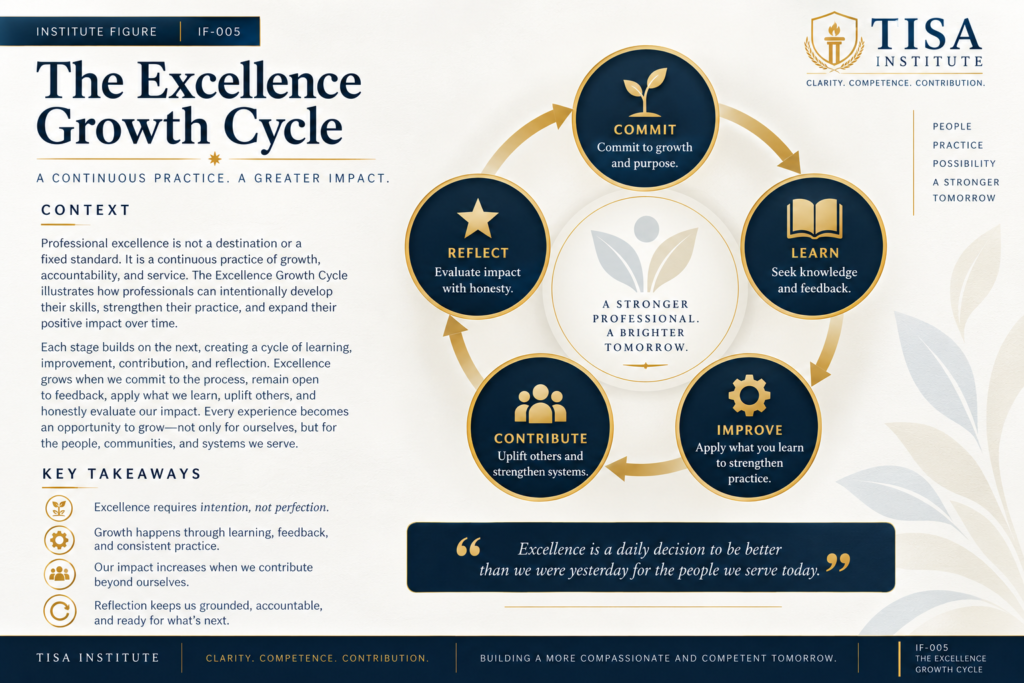
The Excellence Growth Cycle presents professional excellence as an ongoing process rather than a fixed achievement. Professionals commit to growth, seek knowledge and feedback, apply what they learn, contribute beyond themselves, and reflect honestly on the impact of their practice. Reflection then returns the professional to commitment, allowing each experience to inform what comes next.
This cyclical structure recognizes that professional growth does not occur in a straight line. New knowledge may reveal areas for improvement. Practice may expose limitations that were not previously visible. Contribution may create new responsibilities, and reflection may lead professionals to reconsider what excellence requires of them. Returning to Commit is therefore not starting over; it is continuing from a more informed position.
The Cycle also places contribution within the development of professional excellence. Growth is not measured only by what a professional knows or how well they perform individually. Excellence becomes consequential when strengthened practice contributes positively to other people, professional environments, communities, and the systems in which professionals serve.
The Five Pillars of Excellence—Purpose, Integrity, Growth, Service, and Accountability—provide the foundation from which this cycle operates. They do not represent additional stages to complete. Rather, they help ground the professional commitments that give continued growth direction and meaning.
In this way, excellence is neither perfection nor arrival. It is a sustained commitment to learn, improve, contribute, reflect, and continue growing with purpose.
The Cultivation Cycle
Excellence is cultivated through what professionals practice consistently.
The Cultivation Cycle illustrates how professional standards become part of everyday practice through reflection, realignment, adjustment, and intentional engagement. Professionals pause to examine their practice, return to the values and standards intended to guide them, make changes informed by what they have learned, and bring those adjustments into subsequent interactions. Through repetition, professional development moves beyond what a professional knows or intends and becomes reflected in how they consistently practice.
Realignment is not evidence that a professional has failed to uphold a standard; it is a deliberate return to that standard when reflection reveals distance between intention and practice.
Reflect · Realign · Adjust · Engage · Leave a Legacy
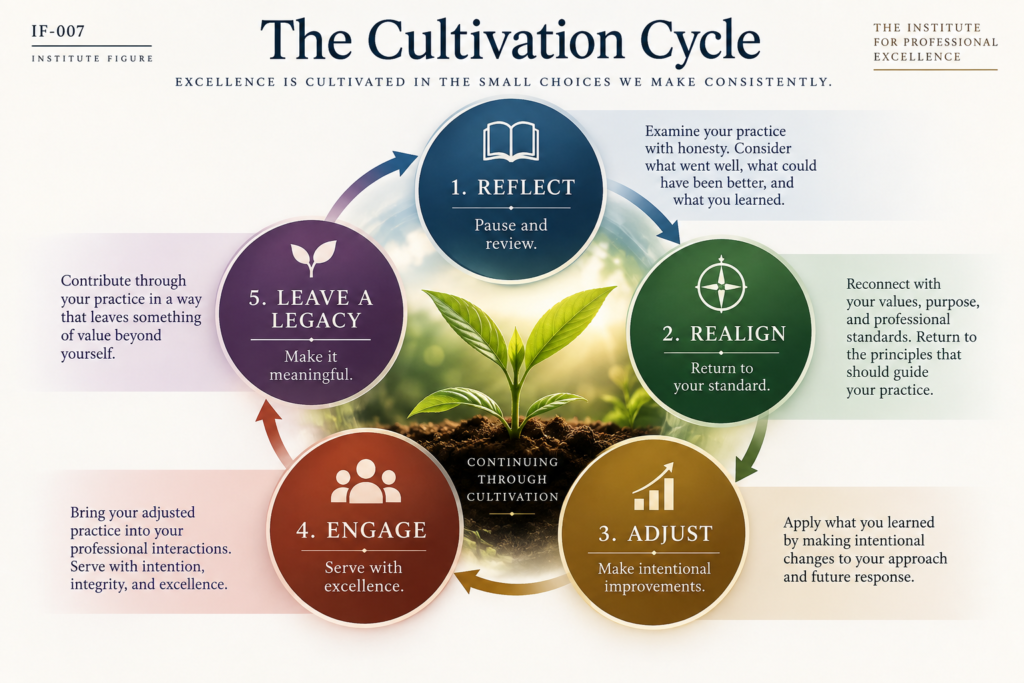
Excellence is cultivated through what professionals practice consistently.
In this way, excellence is not simply something professionals pursue for themselves. What we cultivate individually can contribute to what we build collectively.
The Legacy Continuum
What we practice today can contribute to what continues beyond us.
Professional practice can have consequences beyond the immediate interaction in which it occurs. The choices professionals make, the standards they uphold, and the ways they contribute to others can become part of the collective practices, expectations, and environments that develop around them.
The Legacy Continuum illustrates how professional contribution can extend across time. What is practiced individually today can influence collective practice tomorrow, and what is cultivated collectively may become something others are able to carry forward, strengthen, or build upon.
Today · Tomorrow · Forever
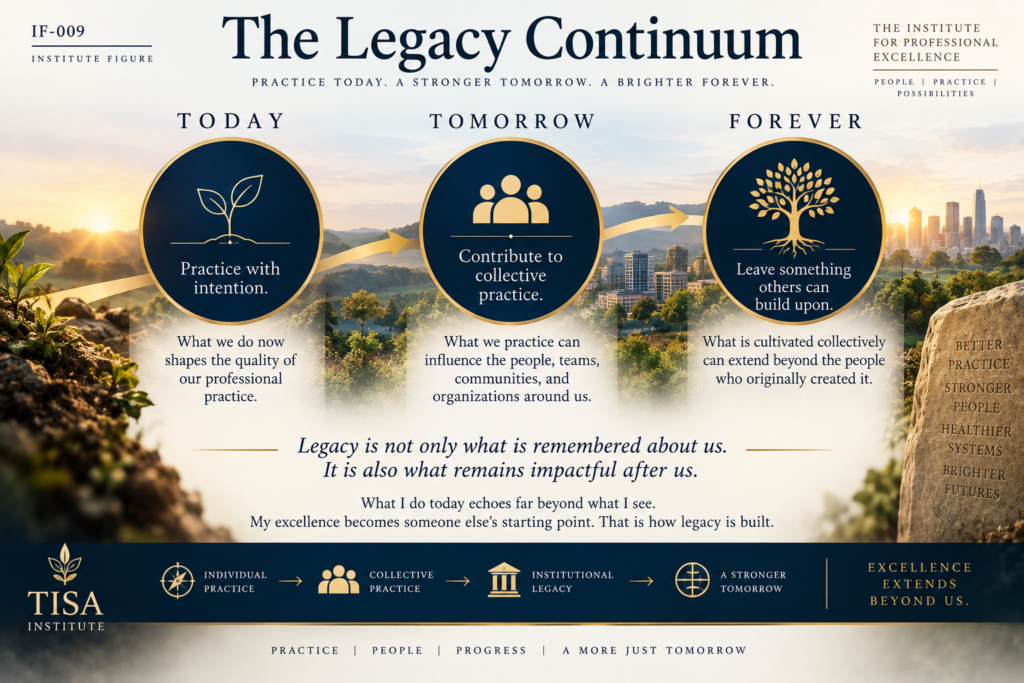
Legacy develops through what our practice contributes beyond the present moment.
The Legacy Continuum illustrates how intentional professional practice can extend beyond an individual interaction or point in time. What professionals do Today shapes the quality of their current practice. Through repeated interactions and contributions, individual practice can become part of the collective practice experienced by teams, communities, organizations, and institutions Tomorrow.
As individual contributions accumulate, they can influence professional expectations, relationships, organizational culture, standards, practices, and systems. In this way, professional legacy is not limited to individual recognition. Individual practice contributes to collective practice, and collective practice helps shape the legacy of the organizations and institutions professionals represent.
Forever does not suggest that every professional action will be remembered permanently or produce an enduring result. Rather, it represents the possibility that what professionals and institutions cultivate can extend beyond the people who originally created it. A strengthened practice may be taught to someone else. A healthier standard may become part of organizational culture. An improved process may continue serving people long after its originator is no longer present. What one generation develops can become a starting point from which another continues to build.
For this reason, legacy should not be confused with visibility, recognition, status, or being remembered by name. Legacy is not only what is remembered about us. It is also what remains impactful after us. The significance of a contribution may reside not in whether its originator receives credit, but in whether something of value continues to influence people, practice, organizations, or systems.
The Legacy Continuum therefore expands professional responsibility beyond the immediate moment. It asks professionals to consider not only what their practice accomplishes today, but also what their practice contributes to tomorrow and what it may make possible for those who come after them.
The Institute Builder’s Framework
Stronger institutions are built through deliberate practice.
Institutions are shaped by more than their missions, policies, or stated values. They are also shaped by how people work together, how decisions are made, how systems operate, and how professional standards are translated into everyday practice.
Strengthening an institution therefore requires more than identifying what it hopes to become. It requires an honest examination of current conditions, alignment between values and practice, attention to the systems that support people and outcomes, meaningful engagement with those affected by the institution’s work, and continued effort to sustain what has been strengthened.
The Institute Builder’s Framework organizes this work into five areas of institutional practice:
Assess Current Conditions · Align with Values · Improve Systems · Engage People · Sustain the Change
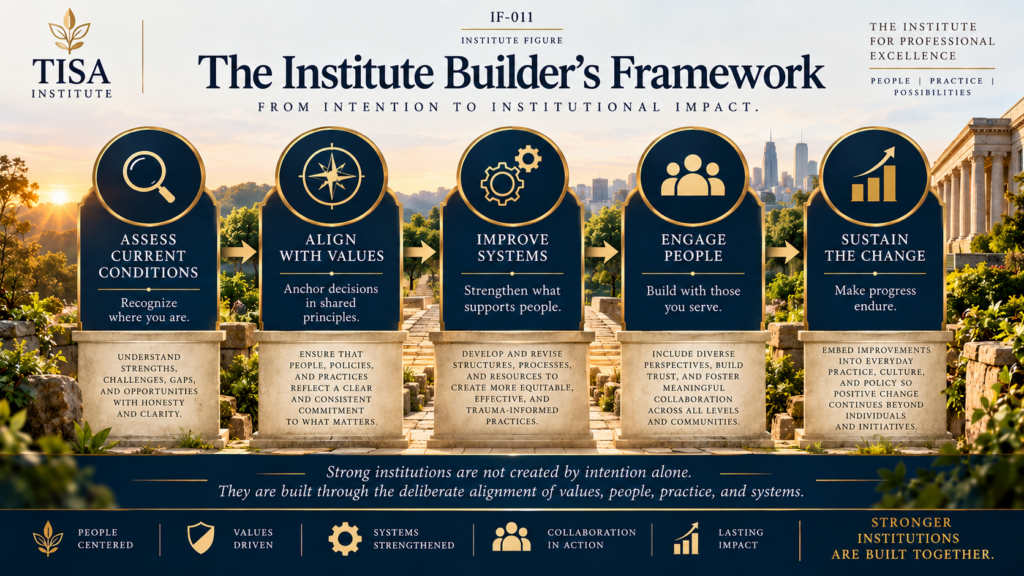
Institutional strengthening begins with recognizing current conditions.
The Institute Builder’s Framework presents institutional development as deliberate practice rather than an expression of good intention. Organizations and institutions may hold meaningful missions, articulate strong values, and pursue positive outcomes while still experiencing gaps between what they intend, what their systems support, and what people actually experience. Assessing Current Conditions requires an institution to examine those conditions honestly enough to understand where strengthening may be needed.
In this sense, institutional development parallels professional self-governance. Individuals cannot govern what they refuse to recognize. Institutions cannot strengthen what they refuse to recognize. Recognition does not require an institution to define itself by its limitations. It creates the opportunity to examine strengths, challenges, patterns, outcomes, and gaps between stated commitments and existing practice so that subsequent decisions can be better informed.
Align with Values moves the Framework from recognition to accountability. Institutional values become consequential when they are reflected in policies, decisions, professional expectations, resource allocation, and everyday practice. Alignment therefore requires institutions to examine not only what they say they value, but whether their structures and practices consistently support those commitments.
Improve Systems recognizes that institutional outcomes are influenced by the structures within which people work. When current systems create unnecessary barriers, produce unintended consequences, or no longer support the institution’s purpose effectively, strengthening the institution may require changes to processes, policies, resources, or other structures. Institutional improvement therefore involves more than asking individuals to perform differently; it also requires examining whether the systems surrounding them support the practice the institution expects.
Engage People recognizes that institutions are collective environments. The people who work within an institution, interact with it, or are affected by its decisions may hold knowledge and perspectives that can help reveal how institutional practices operate in experience. Meaningful engagement does not require agreement among everyone involved, nor does participation guarantee a particular outcome. It requires institutions to create meaningful opportunities for relevant perspectives to inform understanding, problem-solving, and improvement.
Sustain the Change extends institutional responsibility beyond implementing an improvement. Changes that depend entirely upon one leader, initiative, training, or moment of attention may disappear when circumstances change. Sustaining progress requires institutions to consider how strengthened practices become supported through ongoing expectations, processes, resources, evaluation, learning, and organizational culture.
In this way, the Institute Builder’s Framework brings the developmental progression of the Signature Figures into institutional practice. Individual professionals contribute to collective practice, collective practice can shape institutional culture and systems, and institutions can take deliberate responsibility for examining and strengthening what they collectively create.
Strong institutions are not created by intention alone. They are built through the deliberate alignment of values, people, practice, and systems.
Continue Exploring
The Signature Figures are part of the TISA Institute’s broader educational architecture. Continue exploring the Institute’s work in professional practice, professional development, and systemic reform.
The TISA Method
Explore the Institute’s framework for strengthening professional practice.
Professional Development
Explore the Institute’s opportunities for continued professional learning and development.
Systemic Reform
Explore the Institute’s work examining how professional practice, institutional systems, and reform intersect.